

Improving symptom-tracking experience for accurate diagnosis
Timeline
Phase 1 (2024): Research & Strategy
Phase 2 (2025):
UI Refinement
Role
UX Researcher
Product Designer
Team
Myself
1 Product Manager
1 Head of Commercial
1 Head of Clinical Affairs
1 Head of R&D
Summary
Patients with gut health issues track symptoms on a paper diaries that are high friction and low-utility. I led a cross-functional alignment between leadership and clinical teams to establish a strategic research foundation and a cohesive data system designed for long-term patient compliance and diagnostic accuracy.
Impact
Company’s first research repository
Created prototypes and reusable interview templates ready for testing
Unlocked institutional buy-in of the first consumer product
Constraints
Market launch in parallel
Competing user access for product discovery
PROBLEM AREA
Diagnosis relies on patient-reported data, but insights are hard to filter
Patients suffering from functional gut disorders often feel unheard. They can appear healthy in clinical tests and still experience symptoms in daily life. To bridge this gap, clinicians rely on soft-context -- Patient Reported Outcomes (PROs) to treat undiagnosed symptoms.
The Challenge: high friction workflow
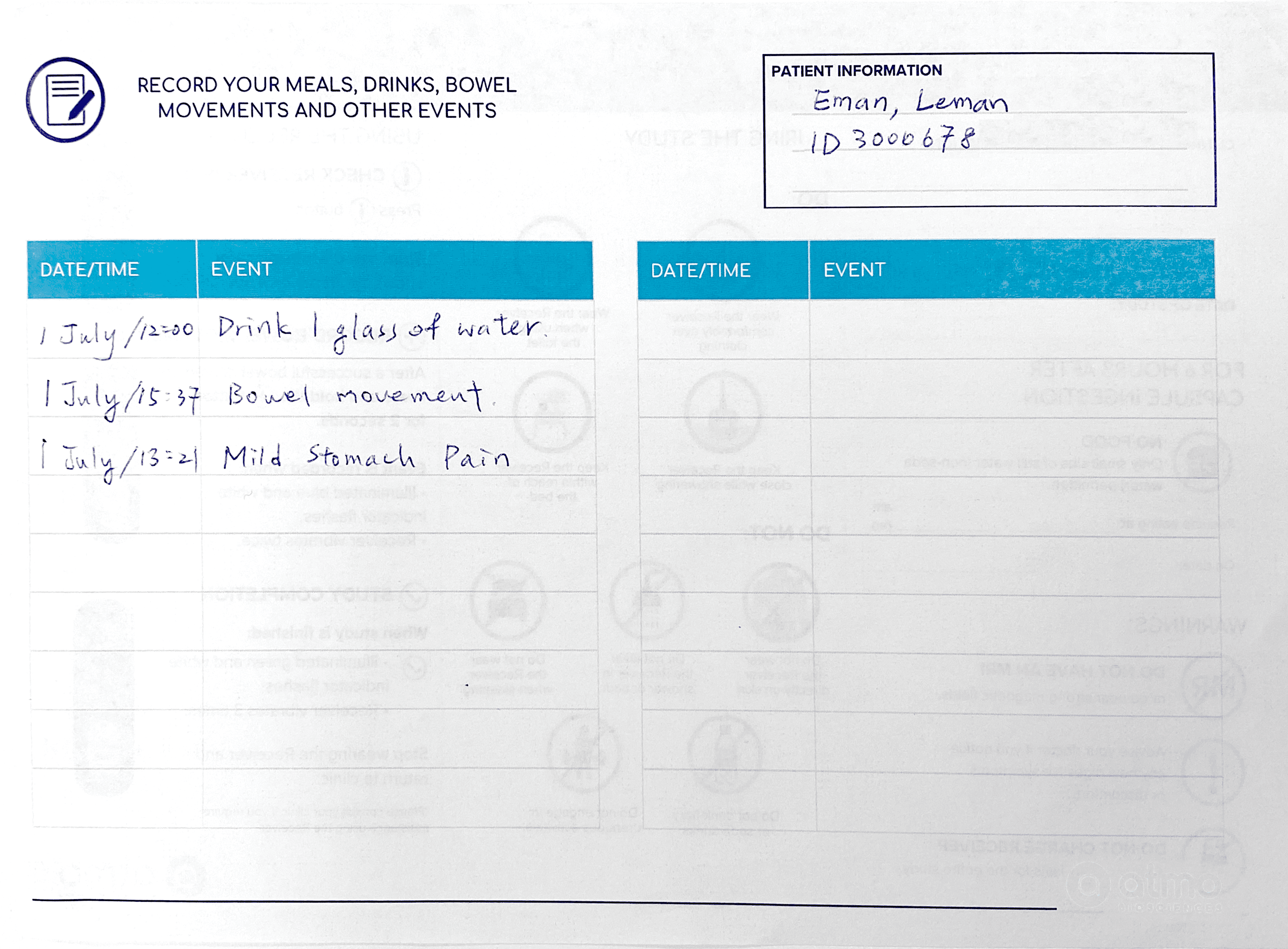
The current tool for capturing this context is a paper diary. However, feedback from clinicians revealed that the system is logistically flawed:

01
Patient records diary
Paper diary is messy and hard to keep track of

02
Nurse files diary
The nurse struggles to transcribe and file the data in their busy workflow.
03
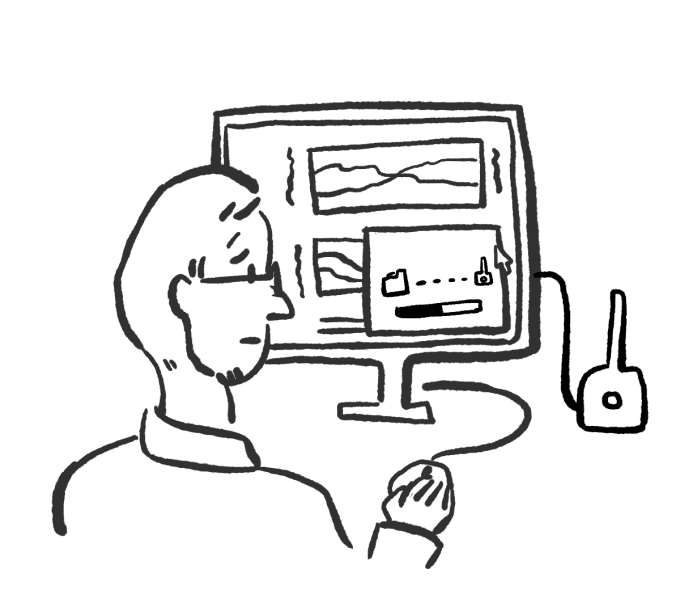
Doctor reviews diary
Extra effort to relate the poor quality data to the clinical test.
hypothesis
Will digitizing the diary close the gap?
As a result, 100% of the customers we interviewed requested a digital app to complement the paper diary.
The business sought this opportunity to align the 3 goals:
Net Promoter Score (NPS), Reimbursement, and Diagnostic Accuracy.
To support this, I lead the discovery phase and built the company’s 1st research repository consisting of:
Competitive Analysis: Patient soft-data is a key leverage for reimbursement.
Interview protocols: Customizable templates structured to uncover “what” the clinician needs in terms of the specific data hierarchy.
The Pivot: Navigating product discovery during market launch
While user bandwidth was prioritized for core product adoption, I pushed the project forward by leveraging clinical affairs team to develop an MVP framework ready to be validated once timeline allowed.
MVP DESIGN
MVP Exploration: Capture the most valuable data with a few simple taps.
To address the challenge, I developed an initial design concept focused on capturing the most clinically valuable data with minimal effort.
BEFORE
Entry is loosely structured
Paper may be lost
Clinicians can’t quickly identify patterns
AFTER
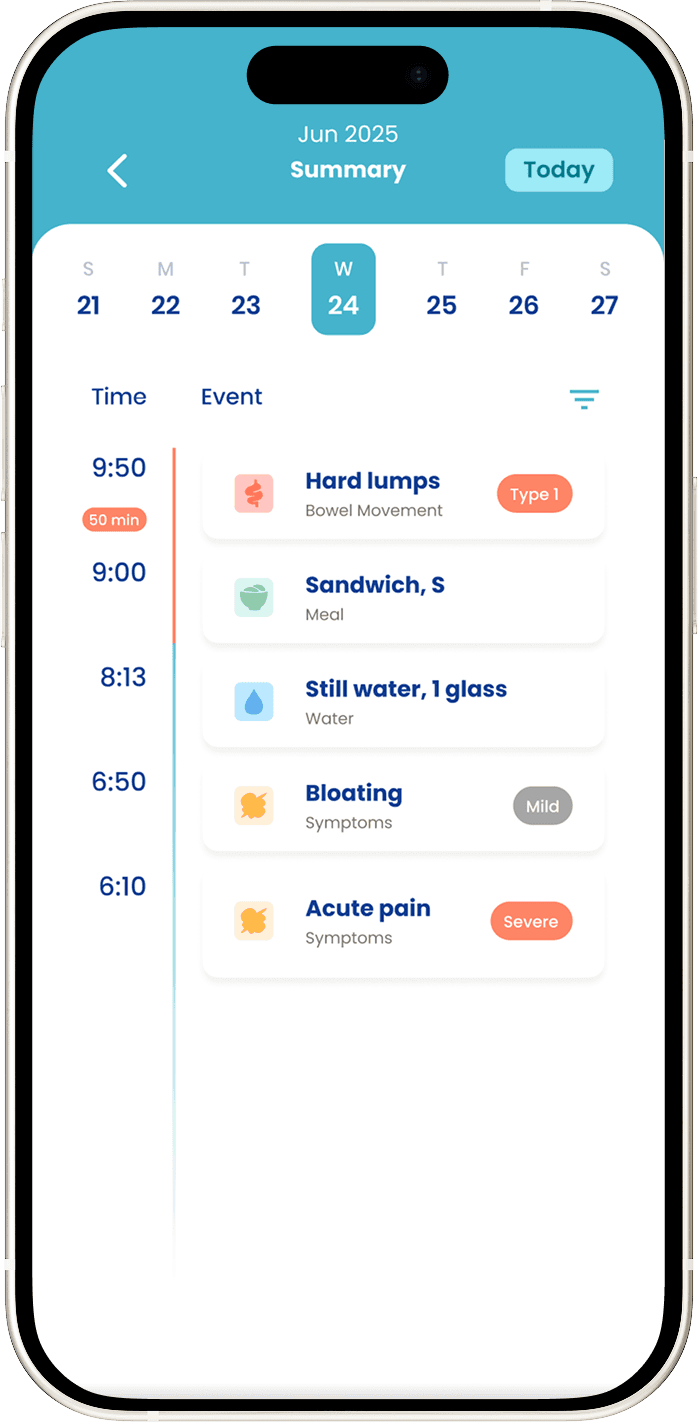
Labelled insights
Accessible data system
Data is preserved from the point the patient records
I started the design with 4 high-signal categories. Patients simply tap and record through guided entry requested by the doctors. I am for doctors to spot a diagnostic pattern within 60 seconds.
I built the 4-category UI as a modular framework -- ready to be replaced with validated data once the upcoming usability tests confirm the patients' mental models and the clinicians' diagnostic priorities.
Check-in
Track
Insights
Check-in
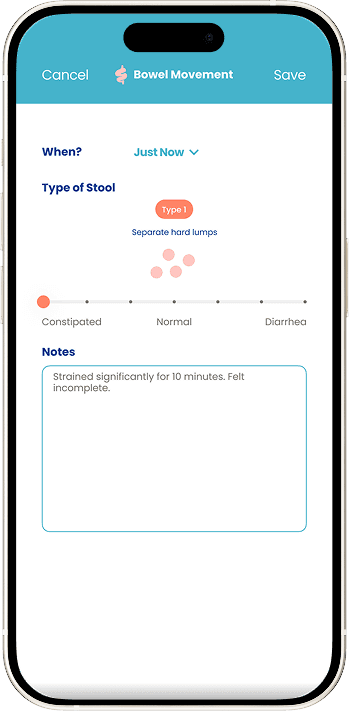
Recording symptoms and bowel movement
Log events with a few simple taps.
4-Category framework
Focused guidance on relevant insights.
Automatic timestamp
Staying on track without manually checking and writing it down.
Labelled entry
Group insights at a glance.
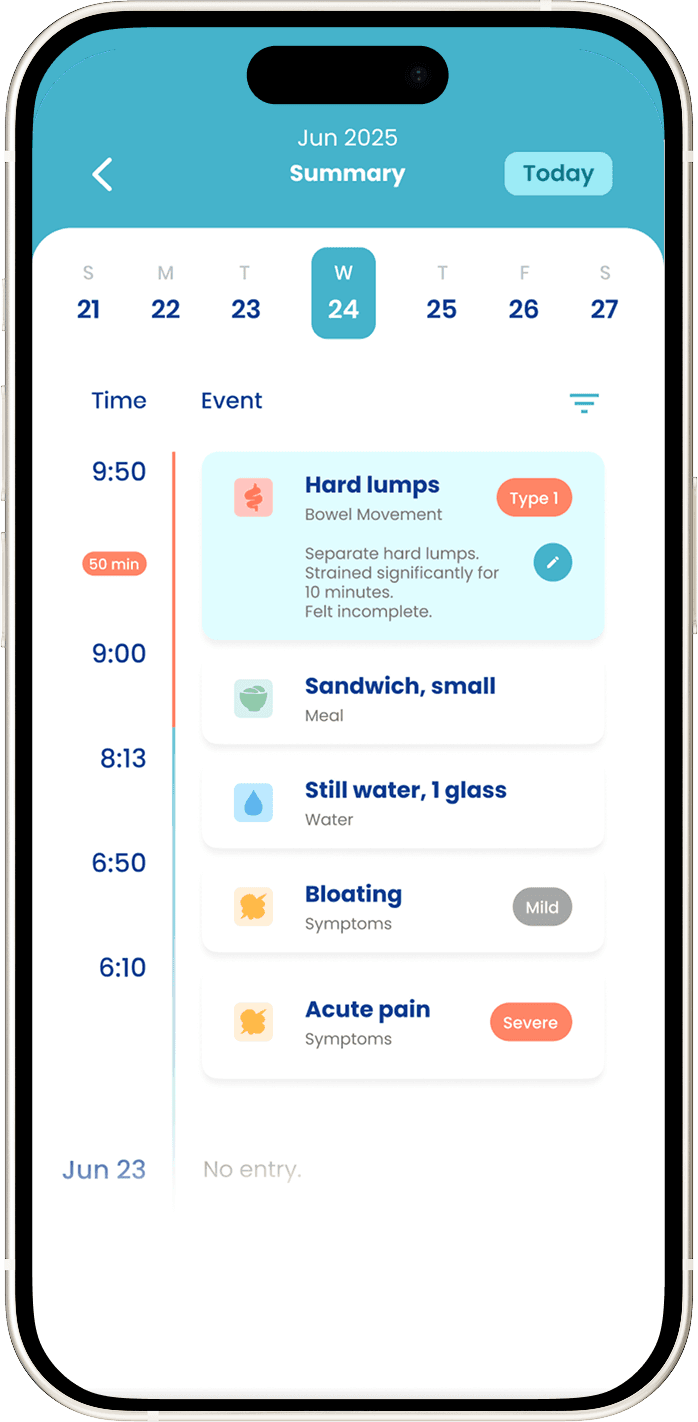
View insights with pre-identified patterns
Timeline
Time is the key for diagnosis. This allows doctors to read the latency between events and make decisions.
Tagged events for attention
System detects the relationships between events and generates tags.
Insights
Viewing insights shown in a timeline
DESIGN CHANGE
Dashboard Alternatives: filtering noise at entry point
The first screen a user sees determines their long-term compliance. I explored three iterations to balance feature requests with clinical clarity:
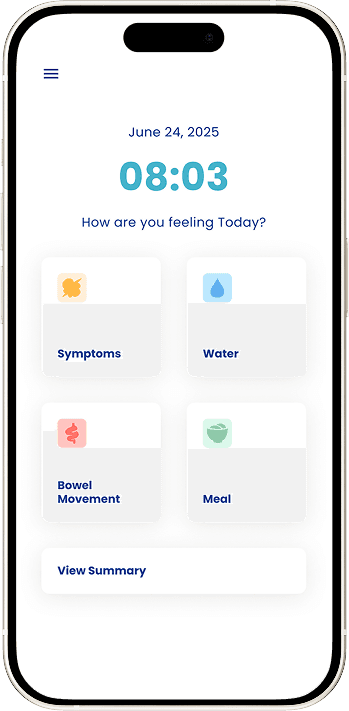
V1
The Minimalist
June 24, 2025
08:03
Add Symptoms
Add Water
Add Bowel Movement
Add Meal
View Summary
No clear hierarchy
Minimal primary navigation
V2
The Full-fledged
June 24, 2025
08:03
Today’s Summary
Bloating, mild
Symptoms
2 hours ago
Still water, 1 glass
Water
Just now
Hard lumps
Bowel Movement
Just now
Sandwich, S
Meal
3 hours ago
Home
Insights
Profile
It’s got all the feature requests
But! While commonly used among successful competitors, it does not reduce the noise for clinicians
Complicated navigation
V3
1-tap logging
June 24, 2025
08:03
Symptoms
Water
Bowel Movement
Meal
Add other events
View Summary
Guides the user towards focused categories
Minimal primary navigation
MVP
Impact
Unlocking a product roadmap
I created valuable templates and stepping stones from the ground that’ll impact future business strategies. The resulting design is not just a digital form, but a tool optimized for clinical utility.
Impacts:
Unlocked the Digital-Health Roadmap: Transitioned the business from a single-device focus to a de-risked digital ecosystem.
Built a Research Repository: Provided the first reusable framework for clinical user discovery, saving weeks of prep for future projects.
Strategic Institutional Buy-in: Secured leadership alignment for a reimbursement-led product strategy.
Target Metrics:
Designed to achieve a 30% increase in data retention and a 10% boost in NPS by removing analog friction.
NEXT STEP
Validating the data hierarchy and correlation
With the system architecture built, the next phase of discovery focuses on perfecting the data density. I will lead the following activities:
Card Sorting for Category Types: Testing with clinicians and patients to identify the 4 symptom groups that offer the highest clarity with the lowest logging fatigue.
Clinician Stress-Test: Presenting the "60-second summary" to doctors to ensure the chosen 4 categories provide enough evidence for a diagnosis.
Optimization: Finalizing the UI labels and icons based on the validated high-signal symptoms.
Also, I want to explore the potential correlation with a clinical test in real-time:
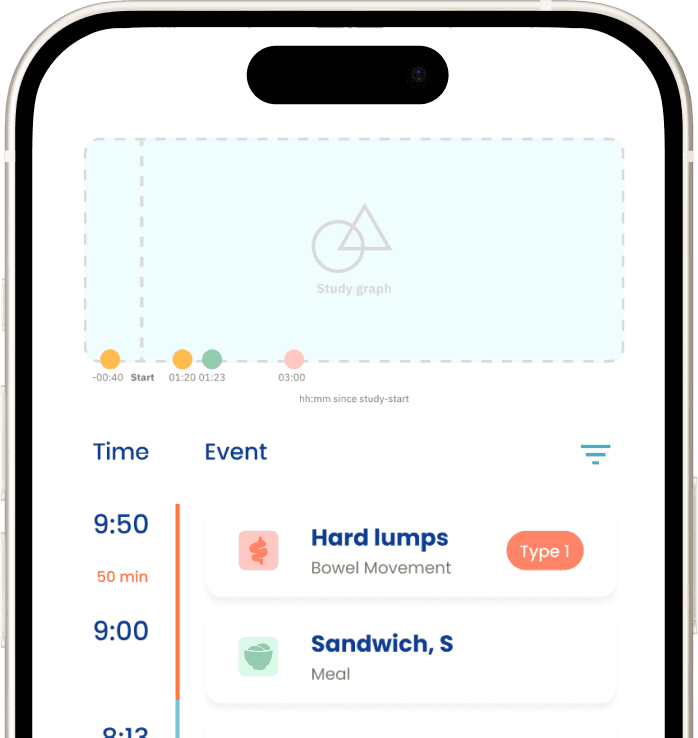
Potentially correlate the timeline of events with the clinical test in progress.
Learnings
Managing risk and resources in a product launch
I learned that in MedTech, a successful launch requires alignment with Finance, Legal, and Regulatory, not just the Product team.
Resources drive the success in a product launch. My analysis found out that reimbursement pathways drives the goal of digital products in Medtech businesses.
By slowing down to define clinician’s need, I moved the project away from a risky feature request bucket and toward a solution designed to solve unmet needs.